
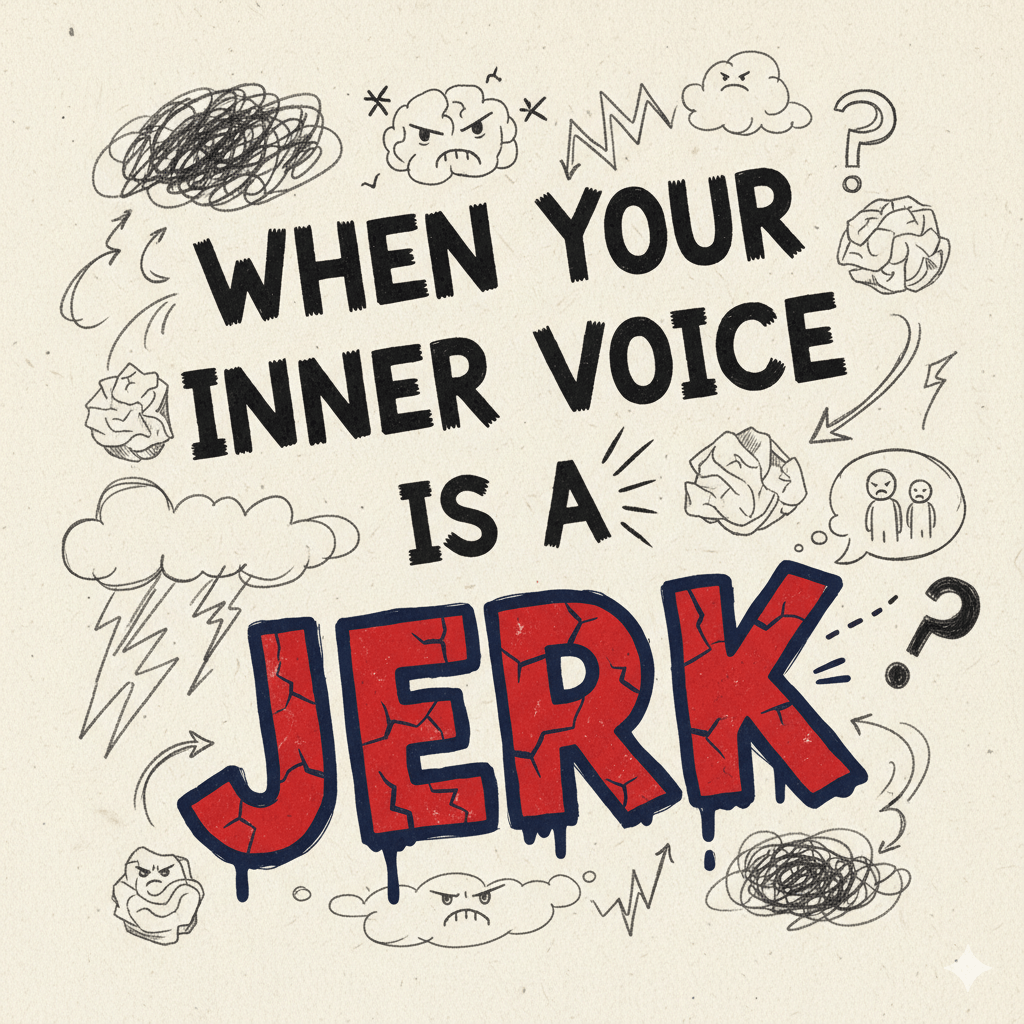
This post follows on from “The Power of Your Thoughts,” diving into how to handle the negative side, when your mind turns on you and your inner critic gets loud. Read on to learn how to silence your inner critic.
You know that voice in your head? Yeah, that one. The one that pipes up right when you’re feeling good and whispers, “Don’t get too excited, you’ll probably mess it up anyway.” Or the one that says, “You’re not as good as them,” while you’re just innocently scrolling through Instagram, sipping your coffee and minding your own business. That voice. The inner critic. The gremlin in your skull. The professional dream smasher. The one who’s somehow louder than your Spotify playlist and never pays rent. It’s time we had a chat about that voice, and more importantly, how to shut it up when it starts talking trash.
Step 1: Realise the Voice Isn’t You… It’s Just Loud
First thing’s first: that voice in your head? It’s not actually you.
It’s like background noise that’s been playing for years, built from every judgment, every comparison, every “you’re not enough” moment you’ve ever collected.
Your brain doesn’t care about facts. It cares about patterns.
And if your pattern has been “doubt, compare, shrink,” it’ll just keep pressing replay.
You’ve got to catch it in the act. Literally.
The next time it starts its little monologue:
“You’ll never make it,” “They’re better than you,” “You sound stupid,” … stop, pause, and say:
“That’s interesting. Who said that, me, or the inner troll?”
It’s powerful because you’re separating your identity from your internal chatter.
You’re saying: I hear you, but you don’t get to drive the bus anymore.
Step 2: Call It Out… Name the Voice
You can’t heal what you won’t face. So let’s face it with a little humor.
Give your inner critic a name.
Seriously. Name it something ridiculous.
Mine is called Doris. Doris the Doom Whisperer (she still lives in my head but doesn’t come out so much anymore).
Because if you’re going to listen to your self doubt, it might as well come from someone wearing a cardigan who complains about everything.
When you personify your inner critic, it loses power.
You’re no longer wrestling your own identity, you’re managing an opinionated background character.
So next time Doris pipes up with, “You’re not qualified for that,” you can roll your eyes and say,
“Thanks, Doris. Go water your plants.”
Playful defiance rewires your brain faster than seriousness ever will.
Step 3: Audit Your Inner Language
Here’s a brutal truth:
If you spoke to your friends the way you speak to yourself sometimes, you’d have no friends.
We let ourselves say things like:
- “You’re such an idiot.”
- “You look awful.”
- “You’re never going to make it.”
That’s psychological self abuse.
And we do it so often we don’t even notice.
So, do a mental audit.
Catch your thoughts in real time. Write them down if you have to.
You’ll start noticing a pattern: your inner dialogue has a tone.
It might be sarcastic. Dismissive. Perfectionist.
Once you hear it clearly, you can start flipping it.
For example:
- Instead of “I can’t do this,” try “This is new for me, I’m still learning.”
- Instead of “I look terrible today,” try “Not my best lighting, but I’m still a vibe.”
- Instead of “I’m failing,” try “I’m in progress.”
You’re not lying to yourself, you’re reframing.
And reframing is where self respect begins.
Step 4: Interrupt the Spiral… Out Loud
When the negative thoughts start snowballing, don’t just sit there and think harder.
Get louder.
Say “STOP” out loud.
Clap your hands. Snap your fingers.
Whatever you need to do to break the thought loop.
Why out loud? Because your brain can’t process internal chatter and external speech at the same time.
So when you interrupt it verbally, you literally hijack your own negativity cycle.
Then follow it with a redirect:
“Stop. We’re not doing that today.”
Or my personal favourite:
“Pipe down, Doris. We’ve got things to do.”
Your thoughts work for you, not the other way around.
Step 5: Replace the Noise with Evidence
Negative self talk runs on assumption.
Confidence runs on evidence.
So let’s gather some.
Every time your brain says, “You’re not good enough,” remind it:
“Oh really? Because I’ve done X, Y, and Z… and I’m still standing.”
Every time it says, “You can’t do this,” you say,
“Maybe not yet, but I’ve figured out harder things before.”
Keep a “proof list.”
Write down every small win, every moment you handled something better than you thought you would, every time you kept going.
This list is your ammunition.
When your inner critic starts shouting, you throw receipts.
Step 6: Learn to Sit in the Discomfort (Without Believing It)
This one’s tricky but essential.
You’re not trying to eliminate negative thoughts, that’s impossible.
You’re learning to coexist without giving them authority.
Think of your thoughts like radio stations.
Sometimes the “You’re Amazing FM” station plays.
Other times, “You’re Trash 24/7” takes over the airwaves.
You can’t stop the broadcast, but you can change the channel.
And sometimes you just need to turn the volume down until it passes.
Let the thoughts come.
Notice them.
Don’t fight them, just say,
“I’m not buying what you’re selling today.”
That’s emotional discipline. And it’s powerful.
Step 7: Watch Who’s Feeding the Voice
The people you hang around, the accounts you follow, the content you consume, all of it fuels your internal dialogue.
If your feed is full of “perfect” people doing “perfect” things with “perfect” lighting, guess what your brain learns?
That you’re behind.
That you’re lacking.
That everyone else got the instruction manual for life except you.
Start curating your inputs.
Follow people who make you feel seen, not smaller.
Spend time with people who remind you of your energy, not your shortcomings.
The internal voice echoes the external world.
So make your world a place that speaks kindly.
Step 8: Stop Waiting to Feel Worthy
We have this lie in our heads: “Once I’m more confident, I’ll speak up. Once I’m more secure, I’ll start. Once I feel ready…”
Spoiler alert: you’re never going to feel ready.
Confidence isn’t a mood. It’s a muscle.
And it only grows through use.
You don’t silence your negative inner voice by arguing with it, you silence it by proving it wrong through action.
Every time you do the thing it told you you couldn’t, you teach your brain a new story:
“I’m capable even when I doubt myself.”
Action kills doubt faster than affirmation ever will.
Step 9: Be Your Own Hype Person
You’ve been your own critic for years.
It’s time to become your own hype team.
Celebrate your wins out loud.
Be cringe if you have to.
Play your victory song. Do the stupid dance.
Because if you’re waiting for the world to clap for you, you’ll be waiting forever.
You don’t need external validation to feel worthy.
You need internal celebration to stay motivated.
So hype yourself up like you would your best friend:
“You did that.”
“You’re handling it.”
“You’re doing the damn thing even when it’s hard.”
That’s how you build unshakeable self-trust.
Step 10: Accept That the Voice May Always Exist… But You Don’t Have to Obey It
The inner critic doesn’t magically disappear one day.
It just gets quieter.
And you get stronger.
It’s like background static, you learn to tune it out and focus on the signal that matters.
The goal isn’t to never think negatively.
The goal is to never let negativity decide for you.
You might hear:
“You’re not enough.”
You reply:
“That’s old programming. I’m rewriting it.”
And then you get back to living.
Final Thoughts: Reclaim the Mic
Your inner voice is powerful — but it’s not the narrator of your story unless you hand it the mic.
So here’s the Oi Mooshy truth:
You can’t always control what pops into your head,
but you can absolutely control what stays there.
You can question it.
You can laugh at it.
You can drown it out with louder truths.
And those truths are simple:
You’ve survived every bad day you’ve ever had.
You’re more resilient than you give yourself credit for.
And your worth doesn’t vanish just because your thoughts forget it for a second.
So the next time your brain starts badmouthing you, smile and say:
“Thanks for your input, inner troll. But I’m running the show now.”
Then go do the thing anyway.
Because that’s what growth looks like… messy, noisy, but yours.
Oi Mooshy takeaway:
Be kind to your mind, it’s been your home since day one.
You don’t need to evict the negative voice. Just redecorate the space it lives in so it has less room to talk.