
There’s a sound echoing across Britain right now. Not the hum of the motorway. Not the 7:42 train apologising for yet another “unexpected delay.” Not even the familiar thud of someone upstairs dropping something and then pretending it didn’t happen. No, it’s the sound of the stiff upper lip finally cracking.
And thank goodness for that.
Because for generations, we’ve survived on a diet of hot tea, cold weather, and emotional suppression that could win Olympic medals. We were raised to believe that feelings were something you apologised for, like stepping on someone’s foot or taking the last biscuit.
Cry? Good heavens, no. We’re British.
Talk about anxiety? Only if we disguise it as a joke.
Admit you’re struggling? Only if you whisper it into your mug of PG Tips when nobody’s looking.
We’ve been conditioned to hold ourselves together with a mixture of sarcasm, apologising too much, and pretending we’re fine even when we’re clearly eight seconds away from a small, polite (away from everyone) meltdown.
But something’s shifting.
Something big.
Something brilliant.
Something overdue.
The stiff upper lip, that badge of honour Grandma told us to wear, is officially… fracturing.
And honestly?
About time.
Because emotional constipation is not a personality trait.
And silence is not bravery.
And bottling it up until you explode in Tesco doesn’t count as “coping.”
So today, in proper Oi Mooshy spirit, we’re diving right into the topic Britain has avoided since the dawn of time:
It’s okay to feel your feelings.
It doesn’t make you soft.
It makes you stronger.
And it makes you actually human.
Let’s get into it.
1. Britain, We Need to Talk About Our National Hobby: Pretending We’re Absolutely Fine
We have a phrase in the UK that sums us up perfectly:
“I’m fine.”
We say it when we’re tired.
We say it when we’re stressed.
We say it when our life is actively on fire.
If you translate “I’m fine” from British to human, it usually means:
- I’m dying inside but don’t want to make a fuss.”
- “Everything’s chaos and I may cry later.”
- “The universe is against me but I’ve already had one breakdown this week.”
- “Please help.”
- “Please don’t help.”
- “I don’t know what I want, just pat my head and make me a brew.”
We’ve been trained by culture, media, history, society, even the weather, to avoid inconveniencing anyone with our emotional reality.
We apologise if someone else bumps into us.
We say “sorry” when we sneeze.
We keep calm and carry on… until something snaps, usually our own patience.
The stiff upper lip is a survival instinct we inherited from people who lived through literal wars, rationing, and people saying “table for one?” like it’s an insult.
But trauma response as culture?
It’s outdated.
It’s unnecessary.
And honestly, it’s exhausting.
Because here’s the truth, Britain:
We’re not fine.
We’ve never been fine.
We’re very good at pretending we’re fine.
And the pretending is what wears us down.
2. The Myth of British Stoicism: A Badge of Honour or a Chain Around Our Necks?
Let’s get one thing straight:
There’s nothing wrong with resilience.
There’s nothing wrong with grit.
There’s nothing wrong with keeping calm in a crisis, someone has to when the nation collectively panics about snow.
But there’s a difference between strength and suppression.
One builds you up.
The other slowly digs a hole you’ll eventually fall into.
The stiff upper lip used to mean:
“Stay strong when it counts.”
Somewhere along the line, Britain translated that into:
“Hide every emotion like it’s contraband.”
People weren’t built for that.
Not in 1925.
Not in 2025.
Not ever.
The old idea of being “strong” is flawed because it assumes strength is the absence of feeling.
Actual strength, the real kind, looks like:
- Being honest when you’re not okay
- Reaching out before you hit the wall
- Letting yourself feel sadness, anger, confusion
- Owning the hard parts of your life without shame
- Crying if you need to (yes, even you, mate)
Strength isn’t silence. Strength is truth.
And that means the stiff upper lip cracking is not a crisis…
it’s a national breakthrough.
3. The Moment Britain Started Cracking Open (And Why It’s Beautiful)
Look around.
People are talking more.
About depression.
About burnout.
About childhood trauma.
About anxiety.
About loneliness.
About the weight we carry in our chests every day like unwanted luggage.
The British public is shifting from:
“Don’t talk about it.” to “Mate, same.”
We’ve gone from “chin up” to: “Yeah actually, I’m struggling. Fancy a cuppa and a chat?”
It’s subtle.
But revolutionary.
And the younger generation?
They’re breaking the emotional curse like Harry Potter smashing horcruxes.
Gen Z says things like:
“I don’t have the emotional bandwidth.”
“I need boundaries.”
“I’m prioritising my mental well-being.”
Most Millennials hear that and panic because we were raised to believe boundaries were rude and “mental well being” was code for “pull yourself together.”
But progress isn’t comfortable.
It’s necessary.
And what a relief it is that the next generation won’t inherit the emotional silence that strangled so many before them.
The stiff upper lip is cracking because we’re finally admitting the obvious:
Humans are emotional. And Brits are humans. (Shockingly.)
4. The Real Reason We’ve Avoided Feelings: Spoiler, It’s Not Because We’re Tough
British people don’t avoid emotions because we’re stoic warriors forged in adversity.
We avoid emotions because we’re awkward.
We’d rather suffer quietly than inconvenience someone with:
- our tears
- our vulnerability
- or God forbid, a meaningful conversation
We worry it will make things weird.
We worry the other person won’t know what to say.
We worry we’re being “dramatic.”
We fear awkwardness more than we fear emotional collapse.
But awkward doesn’t kill you.
Repression can.
And if you strip everything back, all the sarcasm, all the hesitation, all the polite “no worries,” the truth is this:
We ache.
We feel.
We struggle.
We hope.
We hurt.
We heal.
We’re human beings with lives that aren’t simple, hearts that aren’t invincible, and brains that aren’t machines.
Pretending we don’t feel things is the least British thing we do, because Brits love authenticity, even when it’s messy.
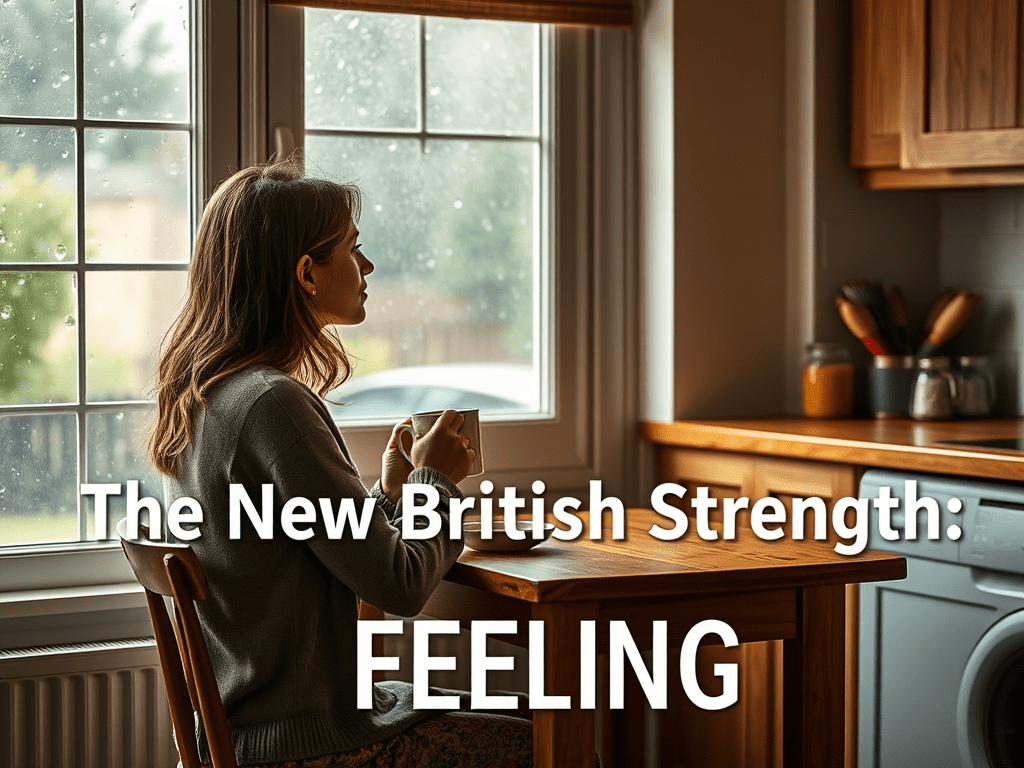
5. The New British Strength: Feeling Your Feelings Without Apology
Here’s the Oi Mooshy truth bomb:
Feeling your feelings doesn’t make you weak.
It makes you brave.
And it makes you powerful.
You know what weakness looks like?
Pretending you’re okay until you fall over.
You know what strength looks like?
Saying, “This is hard.”
Admitting, “I need a hand.”
Sharing, “I’m overwhelmed.”
Owning, “I can’t do this alone.”
The strongest people I know, the ones who truly have resilience, are the ones who’ve stopped performing emotional taxidermy and started living honestly.
They cry.
They care.
They express themselves.
They laugh loudly.
They lean on people.
They show their cracks instead of hiding them.
Because here’s the biggest lesson:
Cracks let the light in.
They let connection in.
They let healing in.
They let humanity in.
A stiff upper lip is a wall.
A cracking one is a doorway.
6. So What Do We Do Now?
It’s simple.
We embrace the crack.
We normalise emotional honesty.
We support vulnerability.
We talk.
We listen.
We stop apologising for having a pulse.
We start saying: “I feel low today.” instead of “I’m fine.”
We start saying: “I need help.” instead of “No, no, I’ll manage.”
We start saying: “It’s okay to be human.” instead of “Don’t make a fuss.”
And when someone else opens up, we don’t panic or freeze.
We don’t dive into toxic optimism.
We don’t say “cheer up.” We say: “I hear you.”
“You’re not alone.”
“Want to talk or want a distraction?” “I’ve got your back.”
That, right there, is the evolution of British resilience.
Not silence. Not stoicism. Not suppression.
Connection. Honesty. Compassion. Courage.
7. Final Thoughts: The Lip Isn’t Breaking Down, It’s Breaking Open
The truth is, Britain doesn’t need to lose resilience.
We need to redefine it.
Real resilience isn’t the absence of emotion.
It’s the ability to experience emotion without being destroyed by it.
And when the stiff upper lip finally cracks and falls away?
We’ll find something better underneath:
Warmth.
Humour.
Strength.
Community.
Healing.
Truth.
Humans weren’t designed to be marble statues.
We were designed to feel deeply. To love fiercely. To hurt honestly. To recover together.
So let the lip crack.
Let the feelings in.
Let the nation breathe for once.
Because this new era of emotional Britain?
It’s not soft.
It’s not weak.
It’s not un British.
It’s the strongest, bravest, most human thing we’ve done in centuries.